
Gold Pricein Nepal Today
Loading...
Gold prices in Nepal change daily and may seem confusing to many people. These prices are influenced by international gold rates, currency exchange, taxes, and local demand. Understanding how gold prices are determined helps buyers make smarter and more confident decisions.
The Federation of Nepal Gold and Silver Dealers’ Association (FENEGOSIDA) is the national body representing gold and silver traders across Nepal. It publishes the official daily gold and silver ratesbased on international gold prices, the USD–NPR exchange rate, government taxes, and local market conditions. Most jewelry shops in Nepal follow these rates, making FENEGOSIDA a trusted authority in gold pricing. The official prices are usually announced every day at around 11:00 AM and may be updated if major international market changes occur.
Gold prices in Nepalare influenced by a chain of steps that start from the global market and end at your local jeweler. Understanding this process helps buyers and investors know why prices fluctuate daily. Here’s a step-by-step breakdown of how gold travels from international markets to Nepal and how its price is determined along the way.
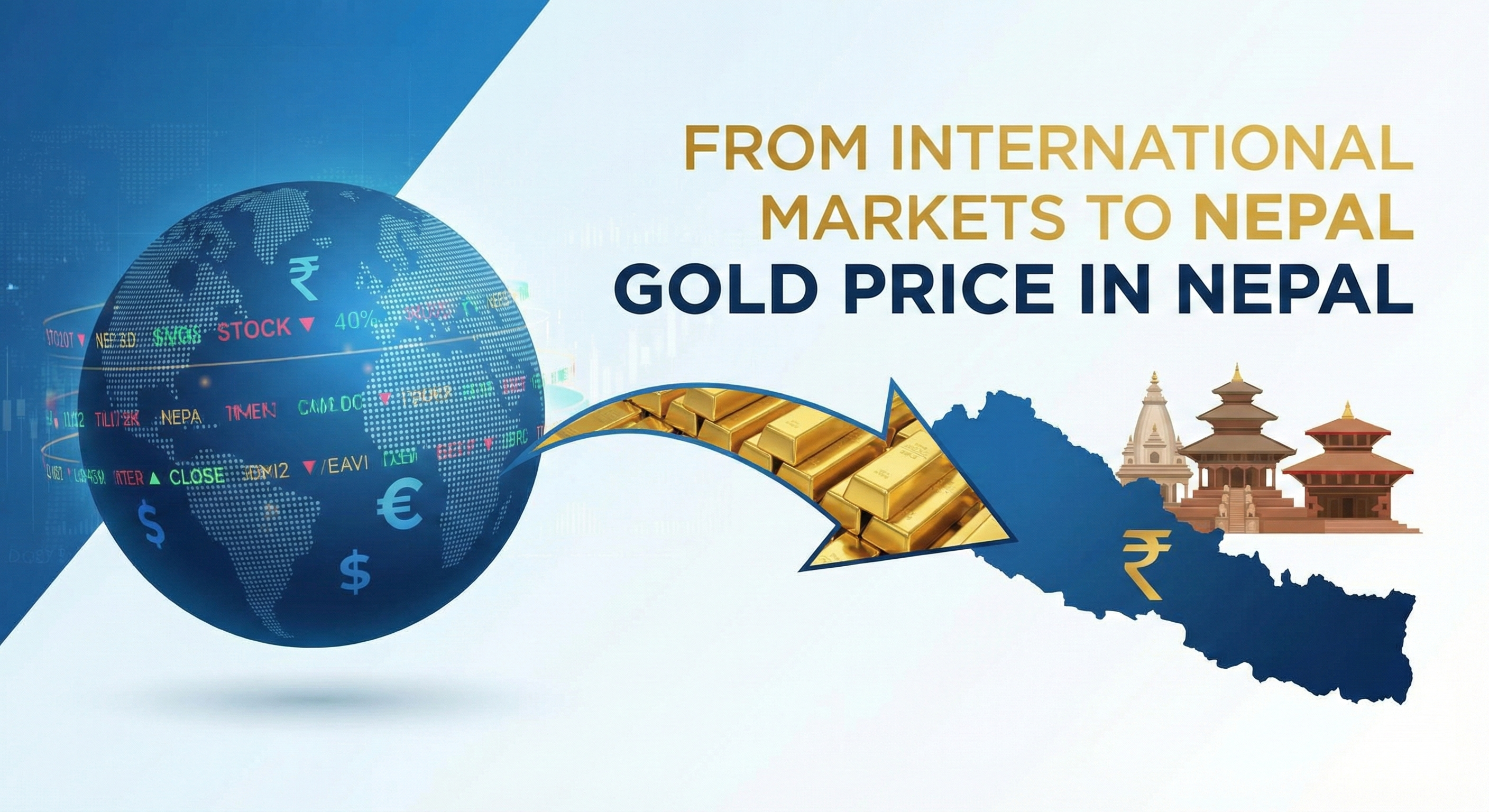
The first factor affecting gold prices in Nepal is the international gold rate, which is primarily determined by the London Bullion Market Association (LBMA). The LBMA sets global benchmark prices for gold traded internationally. Prices are quoted in US dollars per troy ounce, and trading happens in real-time throughout the day. International gold prices are influenced by global economic conditions, central bank policies, geopolitical events, and investor demand. Since Nepal imports gold, these global rates form the foundation of the gold price in the country. Any rise or fall in the international market directly impacts the base price in Nepal.
After establishing the international gold rate, the price must be converted from USD to Nepalese Rupees (NPR). This is done using the current exchange rate, which is influenced by the foreign currency market and monitored by the Nepal Rastra Bank (NRB). Fluctuations in the USD–NPR rate can significantly affect the local gold price. For example, if the rupee weakens against the dollar, imported gold becomes more expensive in Nepal even if the international gold price remains the same. Therefore, currency conversion is a crucial step in calculating the local price for buyers and traders.
Once gold prices are adjusted for currency, the next step is the import process. Gold is imported into Nepal by licensed importers who hold official gold import licenses issued by the government. Importers follow strict procedures, including documentation, quality certification, and compliance with customs regulations. Logistics and timing also play a role: shipping costs, handling charges, and transportation affect the final import cost. Delays or increased shipping expenses can slightly raise gold prices locally, making this step critical in the overall pricing chain.
Imported gold in Nepal is subject to several government duties and taxes that add to its price. Import duty rates are applied to the base price, and the Value Added Tax (VAT) is added on top of this. Other fees may include customs handling charges or regulatory levies. The combination of all these charges forms the total tax burden on gold, which is directly reflected in the price that wholesalers and jewelers pay. Understanding these taxes is important for buyers, as they can sometimes account for a significant portion of the retail price.
Finally, gold enters the local market, where it passes through multiple layers before reaching consumers. Importers sell gold to wholesalers, who in turn supply retail jewelers across Nepal. Importers → wholesalers → retailers with markups, Each layer may add a small markup to cover operational costs and profit margins. This step explains why gold prices at local jewelry shops are slightly higher than the import cost. Seasonal demand, such as during festivals or weddings, can also influence local markups, causing small daily variations in the price. By the time gold reaches the consumer, the price reflects international rates, currency conversion, import costs, taxes, and local distribution margins.
| Component | Approx % | Example / Note |
|---|---|---|
| International Gold Price | Base (100%) | e.g. $2,600/oz → NPR base |
| Import Duty | ~10% | Applied on base value |
| VAT | 13% | On (value + duty) |
| Transportation & Insurance | 1–3% | Logistics costs |
| Importer Margin | ~3–5% | Business overhead |
| Wholesaler Margin | ~2–4% | Overhead |
| Retailer Margin | ~5–10% | Overhead + profit |
| Final Retail Price | ~30–45% above base | NPR per tola / 10g |
When calculating the gold price in Nepal, several cost components combine to form the final retail rate seen in jewelry shops. The international gold price (quoted in USD per troy ounce) forms the base (100%). It is converted to NPR using the current exchange rate, then import duty (~10%) and 13% VAT (on value + duty) are added. Logistics, insurance, and successive margins from importer (~3–5%), wholesaler (~2–4%), and retailer (~5–10%) are layered on top. Altogether, the final price consumers pay is typically 30–45% higher than the international base rate.
Gold prices in Nepal are influenced by a combination of global, regional, and local factors. While international market trends set the baseline, several additional elements determine the daily price consumers pay. Understanding these factors can help buyers and investors make informed decisions and identify the best times to buy or sell gold.
One of the primary drivers of gold prices is the global economic environment. Periods of inflation generally increase gold prices because investors turn to gold as a safe-haven asset, protecting their wealth against currency devaluation. Conversely, deflation or economic stability can lead to lower gold prices. Economic uncertainty, such as recessions or financial crises, also pushes investors toward gold, increasing demand and price. Central bank policies worldwide, including interest rate changes and quantitative easing, heavily influence gold prices. For example, when major central banks reduce interest rates, gold becomes more attractive compared to low-yielding bonds. Geopolitical events, such as conflicts or trade disputes, can also spike gold demand, as investors seek security in tangible assets. These global factors form the foundation of the international gold price, which directly impacts Nepal’s market.
Since gold is traded internationally in US dollars (USD), fluctuations in the USD to Nepalese Rupee (NPR) exchange rate significantly affect gold prices in Nepal. A weaker rupee makes imported gold more expensive, even if international prices remain unchanged. Conversely, a stronger rupee can reduce local prices. Importers and jewelers must consider these daily currency movements when setting retail rates. Therefore, currency volatility is a critical factor in both short-term price changes and long-term trends in Nepal.
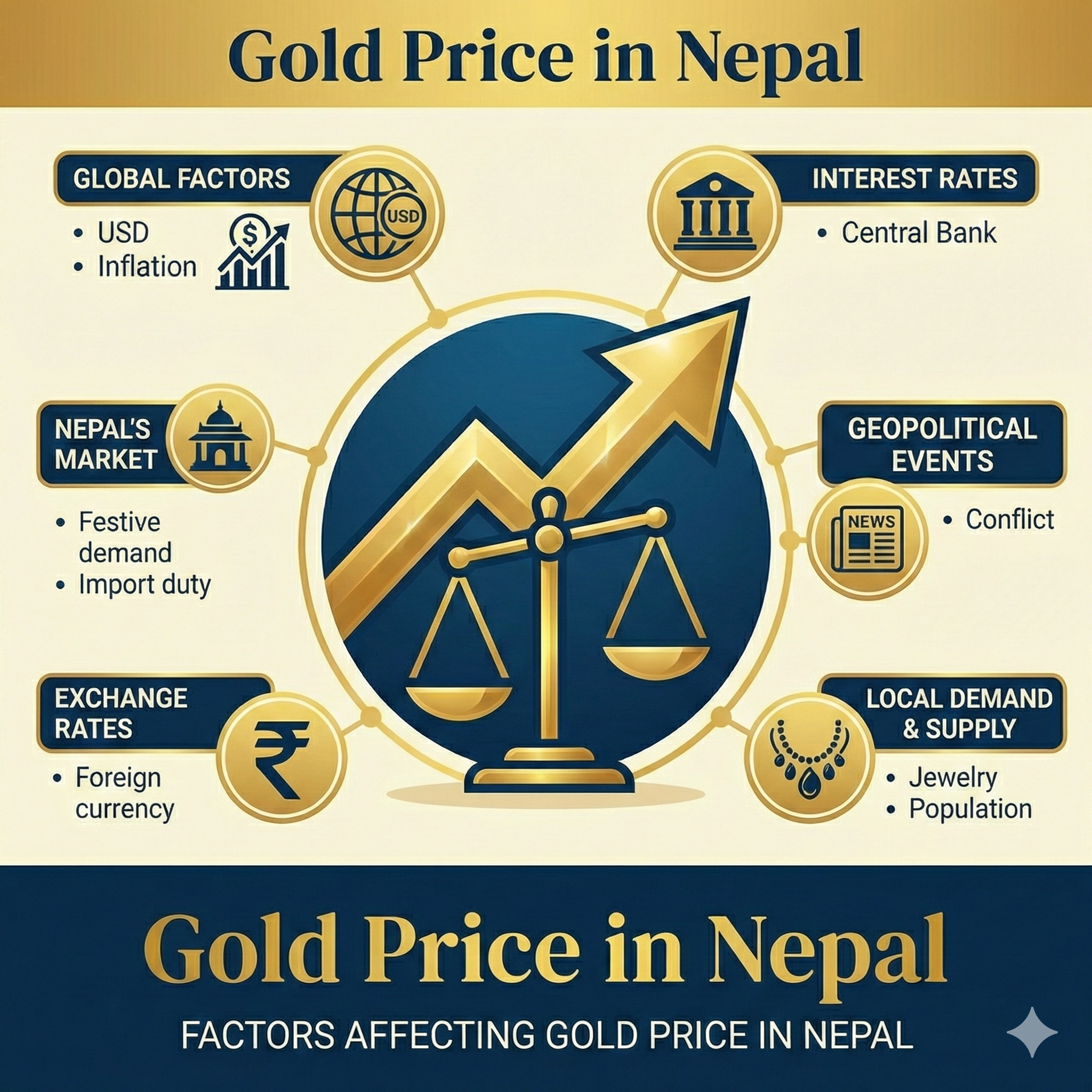
Global supply and demand dynamics are another major factor. Gold production levels, influenced by mining output and exploration activities, affect overall supply. On the demand side, gold is used not only for jewelry, particularly in Asian markets, but also for industrial purposes and as an investment asset in the form of bars, coins, and ETFs. Higher investment demand during times of uncertainty or financial instability can push prices upward. Similarly, strong jewelry demand, especially in countries like India and China, affects global prices and consequently, gold rates in Nepal.
Local factors in Nepal also play a vital role in shaping gold prices. During major festival seasons like Dashain, Tihar, and Teej, and peak wedding seasons (April–May and November–December), demand for gold jewelry surges, often causing small daily price increases. Remittance inflows from Nepali workers abroad can also boost purchasing power, increasing gold demand. Additionally, local economic conditions such as inflation, liquidity, and consumer confidence can influence buying behavior, affecting how jewelers price gold in the domestic market.
Gold prices in Nepal fluctuate daily due to the continuous nature of the international gold market. Globally, gold is traded 24/7 across major exchanges like the London Bullion Market and COMEX in New York. Prices respond in real time to shifts in supply and demand, investor sentiment, economic indicators, and geopolitical events. Even small changes in global markets can influence the base gold rate that Nepal relies on for local pricing. Another key factor is the USD to NPR exchange rate, which changes every day. Since gold is priced internationally in US dollars, fluctuations in the currency directly affect the cost of importing gold into Nepal. A weaker rupee makes gold more expensive locally, while a stronger rupee can slightly reduce prices. Despite these continuous global movements, Nepal updates gold prices only once a day, typically at 11:00 AM, through FENEGOSIDA. This single daily update reflects the previous night’s international market close, the current exchange rate, import costs, and local supply-demand conditions. Updating prices daily rather than hourly helps jewelers maintain consistency and provides buyers with a clear benchmark for the day. In summary, gold prices in Nepal change daily because of real-time global trading, currency fluctuations, and local market adjustments, but the official rate is published once a day to balance accuracy with practical usability for buyers and jewelers.
When buying gold in Nepal, the price you pay at a jewelry shop is often higher than the official gold rate announced by FENEGOSIDA. Understanding the difference helps buyers make informed decisions and avoid overpaying. Several factors contribute to the final retail price beyond the base gold rate.
The base gold rate is the price of pure gold per tola or gram, typically announced daily by FENEGOSIDA at around 11:00 AM. This rate reflects the standard purity of gold, usually 24 karat (99.9% pure), and serves as the benchmark for all calculations. For example, if FENEGOSIDA announces a base rate of NPR 218,000 per tola, this represents the cost of pure gold alone, without any additional charges.
Making charges, also called Banai, are the costs for crafting gold into jewelry. These charges are separate from the gold rate and depend on factors such as the weight, complexity, and design of the jewelry piece.Making charges typically range from 10% to 25% of the gold value. For instance, for a gold necklace worth NPR 218,000, a 15% making charge would add NPR 32,700, increasing the total cost.
Jewelry that includes gemstones, diamonds, or intricate designs will incur additional costs. These stone-setting charges vary depending on the type and quality of stones used. For example, a gold ring with small rubies may add NPR 5,000–10,000 extra, depending on craftsmanship. Even if the gold is pure, these design enhancements increase the final price you pay.
Established jewelry brands often charge a premium over the base gold rate. This covers factors such as certification, branding, warranty, and store reputation. For example, buying the same 1 tola gold bracelet from a well-known brand may cost NPR 5,000–10,000 more than a local unbranded shop. While this adds to the price, buyers often value trust, quality assurance, and authenticity.
In Nepal, GST or VAT is applied on the making charges, not the gold itself. For instance, if the making charge is NPR 32,700 and VAT is 13%, an additional NPR 4,250 is added to the total price. This tax is mandatory and contributes to the difference between the base gold rate and the retail price.
| Component | Amount (NPR) |
|---|---|
| Base Gold Rate (1 tola) | 278,000 |
| Making Charges (15%) | 41,700 |
| Stone Setting & Design | 7,000 |
| Brand Premium | 5,000 |
| GST on Making Charges (13%) | 5,421 |
| Total Retail Price | 337,121 |
The Nepal Rastra Bank (NRB) plays a key role in influencing gold prices in Nepal, even though it does not set daily rates directly. One of its primary responsibilities is managing monetary policy, which affects inflation and liquidity in the economy. Changes in interest rates or money supply can impact the value of the Nepalese Rupee, indirectly influencing gold prices since gold is imported in USD. NRB also oversees foreign exchange management, ensuring a stable USD–NPR exchange rate. Since gold is traded internationally in US dollars, fluctuations in the currency exchange rate directly affect the cost of importing gold. A weaker rupee increases import costs, leading to higher gold prices in Nepal, while a stronger rupee can reduce them. Additionally, NRB enforces import regulations, including licensing and reporting requirements for gold importers. These rules ensure transparency, prevent illegal trade, and stabilize the local market. The central bank’s policies on gold reserves also impact market confidence. By maintaining adequate reserves, NRB supports financial stability and provides a benchmark for gold availability in Nepal. In summary, while FENEGOSIDA announces the daily gold rate, the Nepal Rastra Bank’s monetary policies, foreign exchange management, import regulations, and reserve strategies play a crucial role in shaping the overall gold market. Understanding NRB’s influence helps investors and buyers anticipate price trends and make informed purchasing decisions in Nepal.
Tracking gold prices in Nepal is essential for buyers, investors, and jewelers who want to make informed decisions. One of the most effective ways to do this is by using historical gold price charts. These charts, which can be accessed on our gold price history page, allow you to analyze past price trends, identify long-term growth patterns, and compare seasonal movements. Understanding the difference between trends and daily fluctuations is crucial. While short-term price changes may appear volatile due to currency fluctuations or international market shifts, long-term trends reflect broader economic factors such as inflation, global demand, and government policies.
Recognizing these trends helps to purchase gold more strategically. Seasonal patterns also play a role in Nepal. Gold demand typically rises during festival seasons like Dashain, Tihar, and Teej, and during peak wedding months in April–May and November–December. Monitoring these patterns can help buyers anticipate price increases and avoid paying premium rates. Another useful tool is setting price alerts through online calculators or apps, such as our gold price alert tool. Alerts notify you when gold reaches a target rate, making it easier to buy at a favorable price without constantly checking market movements. By combining historical charts, trend analysis, seasonal insights, and price alerts, you can track and understand gold price movements in Nepal effectively, ensuring smarter purchases and better investment decisions.
Jewelers can add making charges or design premiums, but the base gold rate is set daily by FENEGOSIDA based on international prices, currency rates, import duties, and local market conditions.Check today's rates for accuracy.
Buyers may negotiate making charges, design, or gemstone costs, but the official base gold rate cannot be changed. Knowing which components are flexible helps in smart bargaining.
Most jewelers follow FENEGOSIDA’s daily rate for the base gold price. However, making charges, brand premiums, and design complexity can create small differences in the final retail price.
Gold prices are affected by international markets, geopolitical events, currency fluctuations, and local demand, making accurate predictions impossible. Forecasts are estimates, not guarantees.